
Best Dive Watches Under $1000: 5 Types to Consider
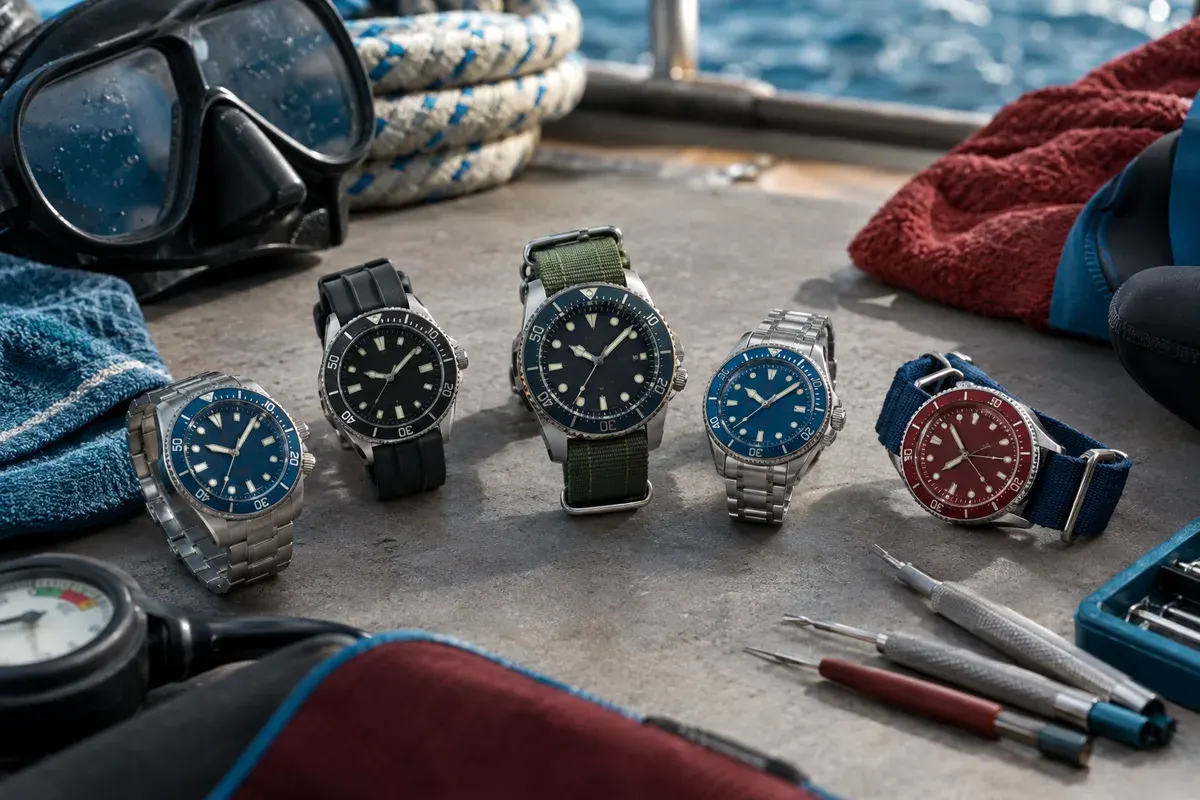
Steel automatics, quartz divers, titanium divers, compact divers, and sapphire-equipped everyday divers serve five useful buying priorities. A steel automatic is the natural choice for someone who enjoys a mechanical movement and substantial wrist presence. Common specifications include a 316L stainless steel case, rotating timing bezel, and luminous hands and markers.
Key takeaways
- A 200-meter rating is a practical starting point for a recreational dive watch.
- Quartz generally offers better accuracy and less routine movement maintenance than an automatic.
- Lug-to-lug length and thickness matter alongside case diameter.
- Sapphire resists scratches, while titanium reduces weight.
- A depth rating alone does not establish ISO 6425 compliance.
In this article
vertigowatches
All Vertigo Watches are covered by a limited international warranty against manufacturing defects.
Which dive watch types are best under $1,000?
Steel automatics, quartz divers, titanium divers, compact divers, and sapphire-equipped everyday divers serve five useful buying priorities.
| Watch type | Defining feature | Best suited to | Main trade-off |
|---|---|---|---|
| Steel automatic diver | Mechanical movement, steel case | Mechanical-watch enthusiasts | Weight and servicing |
| Quartz diver | Battery-powered movement | Occasional wear and accuracy | Battery replacement |
| Titanium diver | Lightweight metal case | Long days on the wrist | Surface wear varies by finish |
| Compact diver | Approximately 36 to 40 mm case | Smaller wrists | Smaller dial and bezel |
| Sapphire everyday diver | Scratch-resistant crystal | Office-to-water use | Impact vulnerability remains |
1. Steel automatic diver
A steel automatic is the natural choice for someone who enjoys a mechanical movement and substantial wrist presence. Common specifications include a 316L stainless steel case, rotating timing bezel, and luminous hands and markers.
An automatic winds through wrist motion, though it stops after its power reserve runs out. It suits regular wear better than long stretches in a drawer. Under this budget, prioritize a serviceable movement and comfortable bracelet over a decorative display back.
2. Quartz diver
A quartz diver suits the buyer who values accurate timekeeping and grab-and-go convenience. It keeps running when unworn, making it useful for a watch rotation or occasional trips.
Quartz movements generally need less routine maintenance than mechanical movements, but battery changes introduce a service requirement. Gasket condition and water-resistance testing still matter. The movement type does not determine whether a watch is suitable for diving; the complete watch does.
3. Titanium diver
A titanium diver is a strong choice when steel feels heavy. Titanium offers lower weight and high corrosion resistance, making it especially useful in a larger case or on a bracelet.
It suits long wear, travel, and buyers who like a substantial-looking watch without equivalent heft. Surface treatments vary, so titanium is not automatically more scratch-resistant than steel. Its chief everyday advantage is comfort.
4. Compact diver
A compact diver, roughly 36 to 40 mm across, suits smaller wrists and anyone who dislikes an oversized sports watch. Short lugs can matter more than a small difference in diameter.
Thickness also changes the experience: a tall case can feel top-heavy even when its diameter looks modest. A compact watch should still provide enough dial space for clear hands, distinct markers, and a readable bezel scale.
5. Sapphire-equipped everyday diver
A sapphire-equipped diver suits someone buying one watch for work, weekends, and water. Sapphire resists everyday scratches better than mineral glass, while an anti-reflective treatment can improve visibility.
A ceramic bezel insert adds scratch resistance around the dial. Neither material is immune to hard impacts. For daily use, balance these durable surfaces with comfortable case edges, manageable thickness, and a bracelet or strap that holds the watch securely.
What do water resistance and ISO 6425 tell you?
Water resistance describes pressure capability, while ISO 6425 covers additional requirements for a diver's watch. The standard starts at 100 meters; 200 meters is a practical shopping target for recreational diving.
Testing includes a pressure margin: a watch rated to 100 meters faces pressure equivalent to 125 meters. Underwater readability matters too, including legibility at 25 centimeters. A printed depth rating alone does not establish compliance with the full standard.
A 300-meter rating provides additional pressure capability, not an automatic upgrade in accuracy, comfort, or suitability for a particular dive. A watch complements dive planning and instrumentation rather than replacing them.
What do our dive watch collections offer?
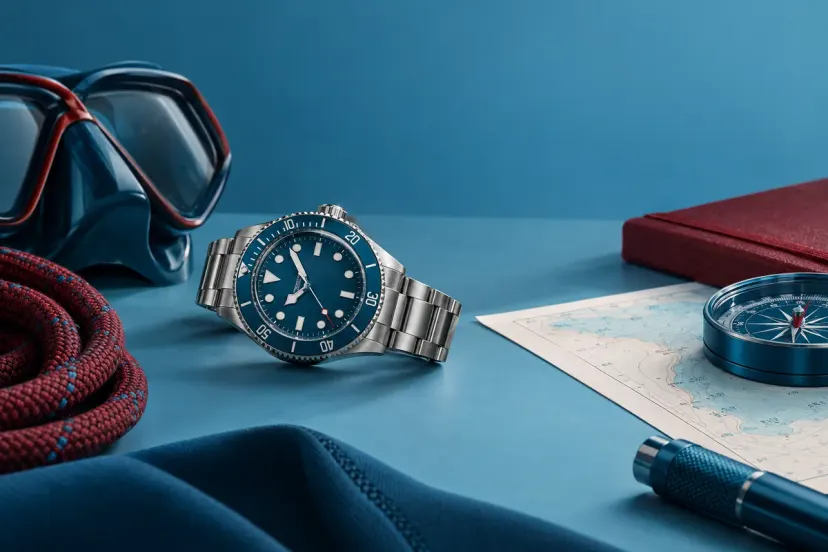
We offer Diver dive watches and Hippocampus dive watches. The Vertigo Diver Two has a 316L steel case, flat sapphire crystal with internal anti-reflective treatment, and a unidirectional 120-click bezel with a ceramic insert.
Its dimensions illustrate why fit deserves attention: 42.5 mm in diameter, 50.5 mm lug-to-lug, and 14 mm thick, with a 20 mm lug width. Its water-resistance rating is 300 meters.
Our contact email is [email protected].
How should you choose among these dive watches?
Choose quartz for convenience, steel automatic for mechanical interest, titanium for lower weight, compact dimensions for restrained fit, or sapphire for everyday scratch resistance.
When two watches meet the same underwater requirements, comfort is usually the more useful deciding factor than extra depth capacity. For occasional wear, quartz avoids resetting a stopped movement. For daily wear, case length, thickness, and bracelet adjustment will be felt far more often than the movement will be seen.
From vertigowatches
Our Diver Two case is made of 316L steel. Our Diver Two has a flat sapphire crystal with an internal anti-reflective treatment. Our Diver Two has a unidirectional 120-click rotating bezel with a ceramic insert.
Frequently asked questions
What is a unidirectional bezel and why does it matter?
A unidirectional bezel rotates in only one direction to track elapsed time. Accidental movement normally makes the indicated elapsed time longer rather than shorter, providing a conservative timing error.
What is the benefit of sapphire crystal on a dive watch?
Sapphire provides strong resistance to everyday scratches. It is not shatterproof, and anti-reflective treatment can be helpful because glare affects readability.
What does lume mean on a dive watch?
Lume is luminous material applied to hands, markers, and sometimes the bezel. It helps the wearer read time and distinguish indications in low light.
Is 316L stainless steel a good dive watch material?
Yes, 316L stainless steel is a widely used, corrosion-resistant watch material. It offers a practical balance of durability, finish, and cost, although it weighs more than titanium.
Are all dive watches automatic?
No, dive watches can use automatic, manually wound, or quartz movements. Water resistance, readability, timing features, and construction determine diving suitability rather than the winding system alone.
Sources
- Diving watchen.wikipedia.org
- ISO 6425 & DIN 8306: The Dive Watch Standard Explaineduhren-nerd.de
- 【F】 ISO 6425 Divers' Watch Standard — What Does It Mean?fratellowatches.com
Research and sources from Crush: Social media ads
Written with help from AI and checked by vertigowatches.
About vertigowatches
Scopri le collezioni Vertigo Watches: orologi subacquei, GMT, racing e da pilota. Design unico, precisione e stile per ogni occasione.
Visit vertigowatches